Logical Compilation: Collapsing Linear Prose into Explicit Proposition Trees
External Computable Environments, Decoding Cost, and Why Natural Language Needs an AST
The Agentic Asymmetry: Why Code First?
The summer of 2024—marked by the release of Claude 3.5 Sonnet and Cursor Composer—was a watershed moment for human-AI interaction. It effectively ended the single-turn “chatbox era” and moved past passive copilots, bringing workspace-aware, multi-file, autonomous agents into production engineering.
Yet this breakthrough exposes a striking structural asymmetry: Why did agentic workflows achieve lift-off in software engineering first, while remaining brittle in long-form writing and complex reasoning?
Beneath the engineering harness, the answer reduces to graph topology. Source code is linear text only on the surface; to a compiler or language server, it is an explicit Abstract Syntax Tree (AST) and symbol dependency graph. Coding agents succeed because they traverse, query, and mutate a deterministic graph structure.
Natural language prose lacks an explicit AST. When we ask an agent—or a human reader—to reason over a 5,000-word essay, we are forcing them to operate on raw, uncompiled surface syntax. This raises a deeper first-principles question: If code derives its computability from explicit tree and graph topologies, what is the equivalent compilation target for natural language thought? To answer this, we must examine the computational substrate of language itself—because graph structures are not merely an engineering trick for RAG or KAG; they are the native topology of human thought once stripped of linear rhetoric.
First Principles: Language and Semantic Topology
1. Language as Dual-Mechanism Infrastructure
Language is an external discrete symbol system that enables humans to transcend biological cognitive limits through two distinct mechanisms:
- Inward: Cognitive Scaffolding. Language crystallizes high-dimensional, transient neural states into persistent, manipulable discrete symbols. By offloading intermediate states onto an external medium, it reshapes the brain’s computational space and drastically reduces working memory overhead. (See Andy Clark, “Magic Words: How Language Augments Human Computation”, 1998.)
- Outward: Communication Protocol. Language standardizes objective concepts and interaction rules across separate minds, enabling cognitive alignment and shared intentionality—the foundational substrate for collective division of labor and coordinated action. (See Michael Tomasello, “Origins of Human Communication”, 2008.)
2. Graph Models and Semantic Grounding
A graph is a non-linear topological data structure composed of two primitives: Vertices (which abstract discrete concepts, entities, or propositions) and Edges (which map the dependencies, derivations, or logical relations between them).
In the domain of semantic representation, neither primitive can carry meaning in isolation:
- Vertices without edges degenerate into a flat set or unindexed array. Like a vocabulary list stripped of syntax, isolated nodes lack relational context and propositional structure; the topological information content drops to zero.
- Edges without grounded vertices collapse into an empty formal skeleton. Like a system of algebraic operators with undefined variables, the relational morphology exists in the abstract, but without semantic grounding, no evaluation or interpretation can occur.
Only when grounded conceptual vertices are woven together by precise topological edges does discrete data cross the threshold into a traversable, computable, and inferable cognitive network.
From Discrete Symbols to Graph Computation
Why can a complex piece of natural language prose be compiled into a compact Argument Knowledge Graph (AKG)? The answer lies in how discrete symbols acquire computability.
1. Symbols, Valuation, and the Private/Public Boundary
Whether in classical physics (such as Newton’s second law, ) or propositional logic (), the lowest-level primitives are discrete symbols. At the purely syntactic level, a symbol is completely vacuous—an arbitrary mark of ink. A symbol acquires meaning only through semantic valuation (or definition), which binds the token to a specific concept, entity, or proposition.
Crucially, semantic validity does not require social consensus as a prerequisite. This distinction marks the exact boundary between language’s inward computation and outward coordination:
- Local Valuation (Inward Computation): As long as a symbol is unambiguously bound within an individual’s cognitive workspace, it immediately possesses computational utility. Just as the same concept is represented by entirely different words across natural languages—or as one programmer may declare
a = 1while another declaresb = 1—a symbol requires no global standardization to function flawlessly inside an individual’s external computable environment, provided its local definition remains self-consistent. - Global Consensus (Outward Protocol): When a symbol’s definition crosses individual boundaries and achieves collective adoption, it standardizes an external concept—upgrading from a private computational operator into a public communication protocol capable of supporting large-scale coordination.
Whether for private deduction or public communication, this symbol-grounding mechanism is strictly isomorphic across rigorous disciplines:
- In physics: Binding to “net force” (itself recursively defined as the vector sum of all external forces acting on a system), to “mass,” and to “acceleration” completes physical grounding.
- In logic and natural language: Binding propositional variable and completes semantic grounding.
2. Rules of Inference and Typed Epistemic Edges
However, grounded vertices and on their own remain static. For symbols to become computable, we must introduce Rules of Inference that operate externally to the symbols themselves.
In arithmetic, these rules take the form of algebraic operations. In formal logic, the engine of state transition is driven by logical connectives and derivation operators:
- Conjunction (): Premises and must hold simultaneously (joint evidentiary support).
- Negation (): Proposition directly falsifies or rebuts .
- Material Implication (): If holds, it leads to ().
- Modus Ponens (): The core state-transition rule—given an established premise vertex and an implication rule , we compute and derive the target conclusion :
Mapped onto a graph topology, these inference rules are directed edges. Vertices hold static semantic states (definitions and claims), while directed edges define how truth values, credences, and justificatory force propagate across the network.
While natural language reasoning is rarely strict binary deduction—operating more often via defeasible, inductive, or abductive inference—the topological mechanism is identical. When mapped to natural language argumentation, formal logical operators generalize into typed epistemic edges: foundational axioms (Fundamental theory), positive inferential support (Establishes), or scope conditions and counter-arguments (Constrains / Rebuts).
Decoding Cost and the Logical Compilation of Prose
Once we accept the axiom that definitions are vertices and inference rules are directed edges, we can re-evaluate everyday natural language prose through the lens of information theory—and a striking realization emerges:
Any article or essay written to convey ideas or prove a thesis is, under the hood, a symbolic logical derivation wrapped in natural language rhetoric.
Why does traditional linear prose so often feel verbose, opaque, and cognitively expensive to audit? Because human thought is natively non-linear and topological, yet traditional writing media force authors to serialize this multi-dimensional graph into a one-dimensional stream of tokens. To accommodate linear reading habits, writers must pad core propositions with transitional phrasing, stylistic variation, and rhetorical fluff.
This creates a massive epistemic tax:
- Encoding (Serialization): The writer flattens an internal argument graph into a linear stream of prose.
- Decoding (Deserialization): The reader—or an LLM agent—must burn working memory and compute parsing that linear text, stripping away the rhetorical padding to reverse-engineer the underlying logical graph inside their own head.
This reconstruction overhead is precisely the decoding cost of prose.
If we subject a long-form essay to Logical Compilation—stripping away emotional framing and linear syntactic glue—the text undergoes an immediate topological collapse:
- Paragraphs collapse into Atomic Proposition Vertices: Every substantive definition, empirical claim, and thesis statement is distilled into a disambiguated atomic proposition node (e.g., “Language is an external discrete symbol system that enables humans to transcend biological limits”).
- Contextual transitions collapse into Typed Computational Edges: Hundreds of words of transitional prose (“Building on the foundational principles outlined above…”, “From this mechanism we can demonstrate…”, “However, this conclusion holds only under the constraint that…”) map cleanly onto a small set of standardized directed edge operators—such as
Fundamental theory(axiomatic grounding),Establishes(forward inferential support), orConstrains(negation and boundary limits).
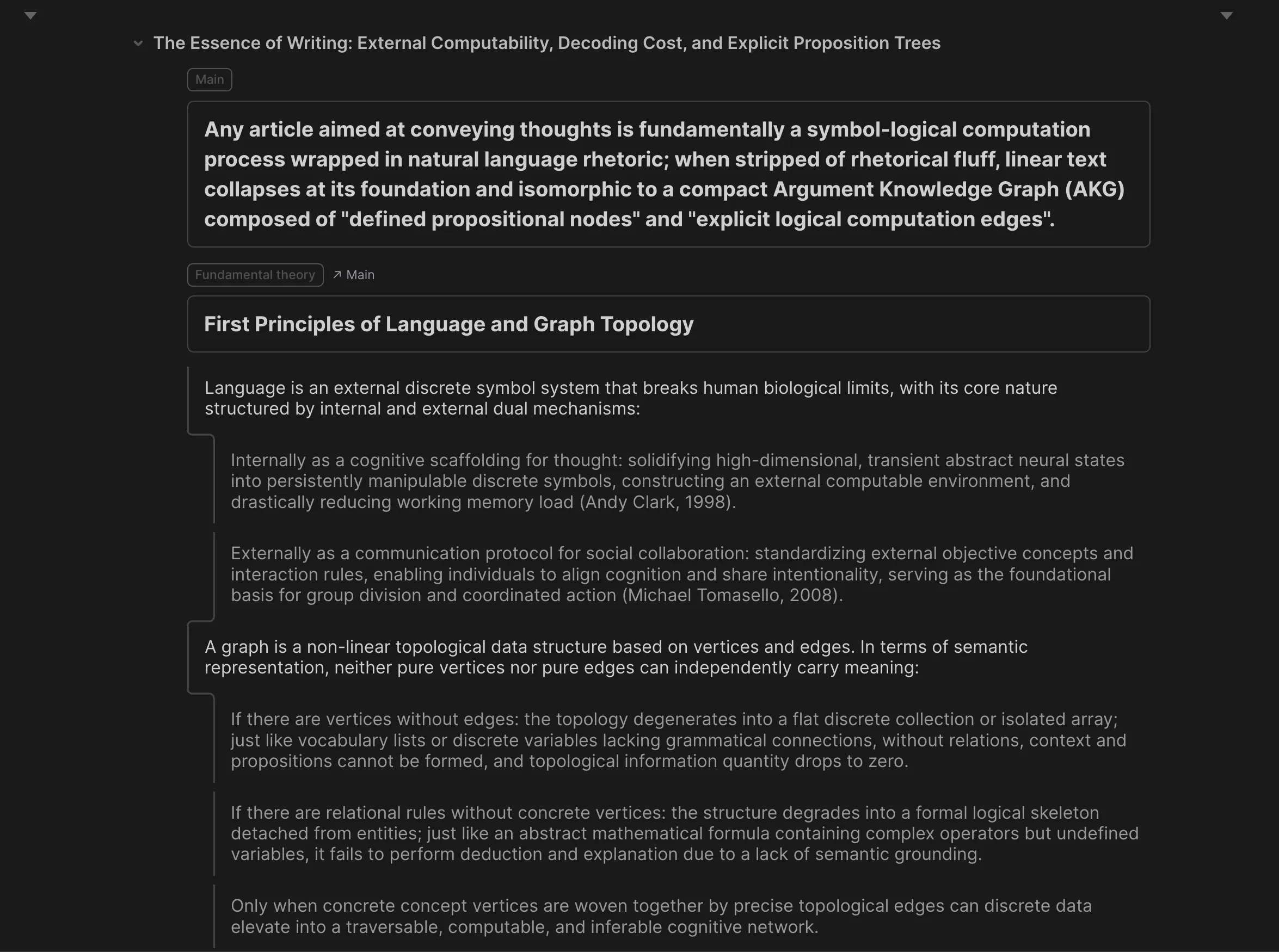
As illustrated in the diagram above, when we apply Logical Compilation to a multi-thousand-word essay on the nature of writing, the linear prose collapses and converges into a compact, computable Explicit Proposition Tree (a tree-structured AKG):
- The Root Vertex (
Main) represents the target theorem of the entire derivation: “The essence of good writing is minimizing the reader’s decoding cost and actively designing a feedback loop.” - The Child Vertices mounted beneath it are independently grounded atomic propositions—such as “Language constructs an external computable environment outside the brain.”
- The Edge Labels at the top-left of each block (e.g.,
Fundamental theory -> Main,Establishes -> Main) explicitly declare the epistemic operator governing how each child proposition computes toward the parent claim.
At this point, text ceases to be an amorphous cloud of literary rhetoric and returns to its first-principles form: a minimal Argument Knowledge Graph (AKG) composed of defined propositional vertices and explicit logical edges. In this compiled representation, neither human thinkers nor AI agents need to expend compute guessing the implicit relationships between paragraphs; both can directly traverse, verify, and extend the architecture of thought inside a shared, external computable environment.
Epilogue: From Theory to Implementation
The proposition-tree interfaces shown in this post are not static mockups. They are screenshots from
FluxLinks, a reasoning and writing workbench I’ve spent the past four months building to explore a
practical implementation of the Argument Knowledge Graph (AKG) framework described above.
I started building it out of frustration with a familiar tooling dilemma: bidirectional note-taking apps
lack edge polarity—causing complex arguments to degrade into an uncomputable web of associations—while
traditional linear editors force us to burn cognitive cycles on rhetorical transitions rather than
structural validity.
FluxLinks is my attempt to explore an alternative: an external workspace where thoughts are decomposed
into atomic propositions and assembled into explicit argument structures, with typed relations such as
Fundamental theory and Establishes.
The system is live at https://fluxlinks.com.
I’m sharing it not as evidence that the AKG framework is already validated, but as a working
implementation that makes the underlying design choices concrete. If you work with complex arguments or
research synthesis, I’d especially appreciate critiques of the relation types, the underlying ontology,
and the limits of representing arguments as trees or graphs. Where does this representation help, and
where does it distort the way you actually reason?