Problem-Solving Strategies: A Step-by-Step Guide for Complex Business Challenges
Master structured problem solving strategies. From classic tools like 5 Whys to logic trees and Means-Ends Analysis, learn how to resolve tough business bottlenecks.
Key takeaways (TL;DR)
- Core: Problem solving is closing the gap between current reality and a target outcome. The standard cycle has four steps: define the problem, analyze root causes, develop solutions, and implement & monitor.
- Limitation: The traditional approaches such as 5 Why and PDCA are effective at solving issues in deterministic systems. However, their effectiveness reduces in complex coupled systems with non-linear interdependencies.
- Dual process solution: In complex business problems it is effective to solve problems by combining analysis (logic trees) with implementation (Means-Ends Analysis), to avoid getting stuck in analysis and local dead ends.
(Case study note: This guide integrates an anonymized, first-hand account of resolving an onboarding bottleneck in an offline retail analytics startup.)
What is a problem-solving strategy?
A problem-solving strategy is a repeatable, structured plan of action used to identify the root cause of an obstacle, close the measurable distance between current reality and a target outcome, and verify corrective steps through objective feedback.
Understanding the reality-to-goal gap
When teams face a sudden obstacle, their first instinct is often to brainstorm random fixes. In cognitive science, effective problem solving is not spontaneous ideation. It is a systematic process designed to measure and close a specific gap between where you are and where you need to be.
Without a clear definition of your current reality and target goal, any solution risks solving the wrong issue. To master what problem solving actually entails, teams must move beyond intuition and anchor their work in objective metrics.
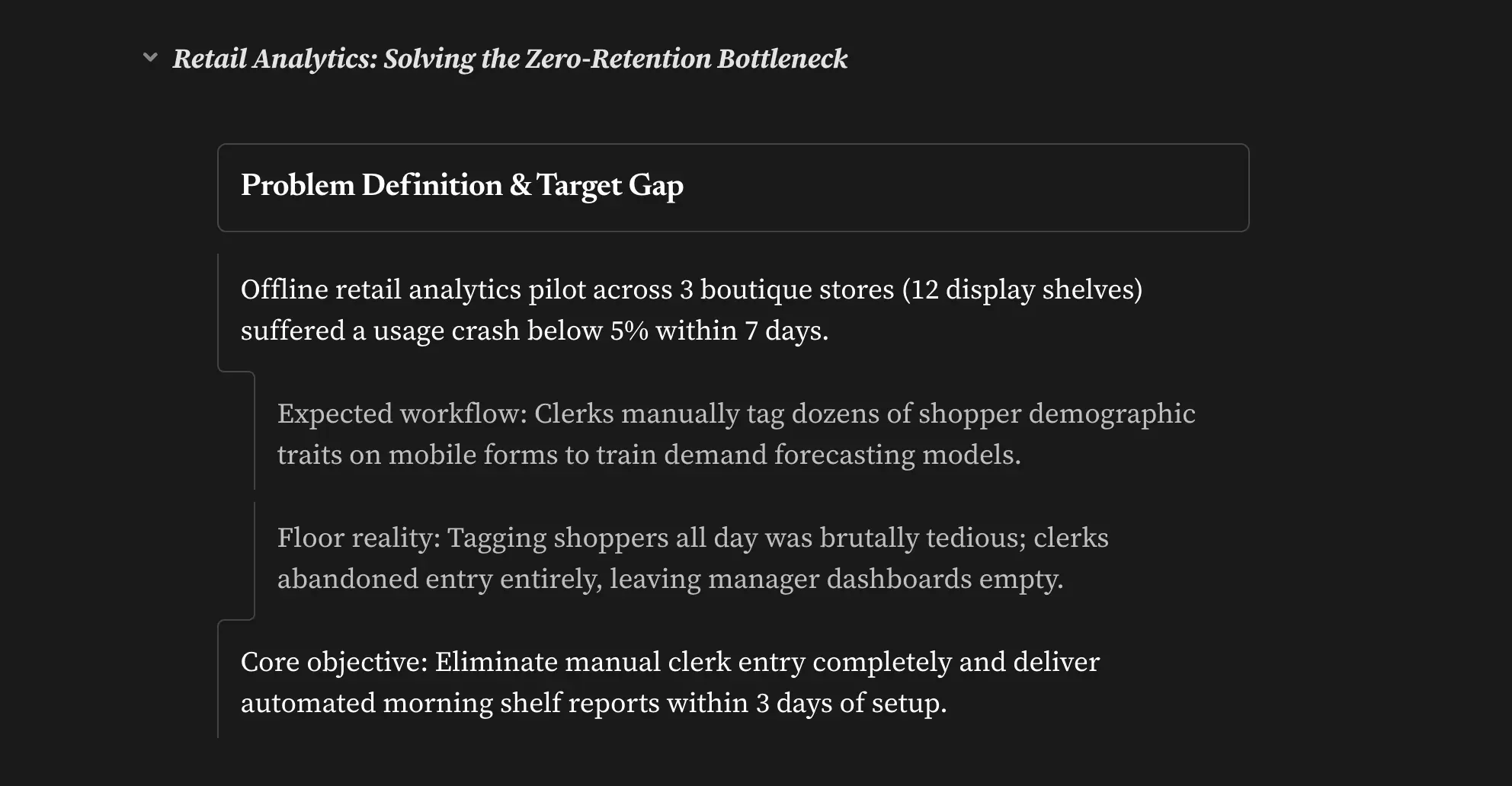
Case study (Part 1: The week-one retention cliff)
A few years ago, I co-founded a startup where we were developing a combined software and sensing solution for physical retail environments. We developed software which allowed store managers to understand consumer preferences, and therefore forecast stock demand.
Challenge
In our initial pilot deployment, we found significant challenges. To train the recommendation system, retail staff needed to manually enter numerous demographic labels about consumers using a mobile application. This was very cumbersome for staff. As a result, by the end of week 1 of the pilot, less than 5% of staff were continuing to input data (data input ceased in all 3 retailers). The business value was not delivered to store managers at all, as staff became frustrated with the system.Aim
Reduce friction in data collection to almost zero, produce first automated insights into in-store shelves within 3 days of set up, and increase retention in trials to a healthy level.
What are the 4 universal steps to solve any problem?
The four universal steps to solve any problem are defining the root problem, analyzing root causes, developing and evaluating potential solutions, and implementing the solution with continuous feedback monitoring.
Step 1: Define the problem
Map the exact gap between your baseline state and target outcome. Document when the issue occurs, who it affects, and which metrics quantify the failure. Avoid mistaking a visible symptom (such as “clerks are disengaged”) for the root problem.
Step 2: Deconstruct and analyze root causes
Trace the causal relationships behind the gap. Simple operational faults can often be diagnosed directly through expert inspection. In complex environments with multiple variables, this step expands into structured logic trees and targeted hypothesis testing.
Step 3: Develop and evaluate potential solutions
Generate candidate options and evaluate them against real constraints: engineering budget, rollout speed, user resistance, and organizational friction. Pick the simplest path that satisfies your requirements.
Step 4: Implement, monitor, and iterate
Deploy your chosen intervention in the live environment and set up low-latency telemetry. If live feedback diverges from your model, backtrack and adjust parameters immediately.
How do algorithms and heuristics differ in problem solving?
An algorithm produces a single definite outcome when following exact, repeatable steps. A heuristic is a practical rule of thumb based on prior experience, trading formal mathematical precision for speed and efficiency by accepting approximate, “good enough” answers under cognitive constraints.
Algorithms vs. heuristics: certainty versus bounded rationality
In cognitive psychology and computer science, humans rely on two distinct paths:
- Algorithms: Best suited for closed systems with transparent rules (such as long division, sorting numbers, or balancing accounts). Algorithms guarantee 100% precision, but in open-ended or uncertain environments, evaluating every possible state triggers combinatorial explosion.
- Heuristics: Practical shortcuts shaped by human evolutionary experience. Herbert Simon (1957) formulated the concept of bounded rationality: because people can process only limited information with finite cognitive capacity, real-world decision-makers do not seek global mathematical optima. Instead, they seek satisficing outcomes that are practical and satisfactory within existing boundaries.
Industry misconceptions: when heuristics fail vs. when they win
Heuristics are often misunderstood in popular business literature, where rules of thumb are wrongly dismissed as careless guesses or confused with deterministic formulas. Cognitive science maintains a balanced, two-fold view:
- When heuristics fail (Tversky and Kahneman, 1974): When people rely unreflectively on intuitive shortcuts during sudden regime changes, they make systematic errors such as availability bias and anchoring.
- When heuristics succeed (Gigerenzer et al., 1999): In environments with high uncertainty and sparse data, simple heuristics (what cognitive scientists call “ecological rationality”) often produce more accurate results than complex predictive models by avoiding overfitting.
Most problems faced in business cannot be solved using deterministic algorithms. As a result, heuristics are commonly deployed to navigate open-ended challenges. Many classic workplace tools (such as the 5 Whys, fishbone diagrams, and working backwards) are heuristics rather than algorithms. They deliver fast, “good enough” solutions, but they inevitably fail when stretched beyond their intended operational boundaries. Below is a breakdown of 6 classic problem-solving heuristics used in modern organizations.
What are the 6 classic problem-solving strategies in the workplace?
The six classic workplace problem-solving strategies are the 5 Whys, fishbone diagrams, trial and error, working backwards, PDCA cycles, and collaborative brainstorming.
Classic toolkit: mechanics and boundary conditions
| Classic strategy | Core mechanism and definition | Best suited for | Where it breaks down |
|---|---|---|---|
| 1. The 5 Whys | Tracing a single vertical causal chain by asking “why” repeatedly until reaching a root condition. | Linear causal chains, single-point mechanical faults, or operational protocol breaches. | Coupled systems: Artificially isolates one variable in multi-variable networks, obscuring systemic feedback. |
| 2. Fishbone diagram | Brainstorming causal factors horizontally across fixed categories (people, machines, methods, materials). | Manufacturing quality audits and multi-factor operational reviews. | Static inventory: Categorizes variables without showing causal hierarchy, weights, or dynamic feedback. |
| 3. Trial and error | Testing candidate options sequentially until reaching a workable result. | Low-cost, non-destructive environments with immediate physical feedback. | Combinatorial explosion: Fails when the variable space is wide or individual failure costs are unacceptable. |
| 4. Working backwards | Starting from the target outcome and deducing required prerequisites in reverse (Pólya, 1945; Amazon PR/FAQ). | Architectural milestone mapping and initial product concept design. | Lack of dynamic navigation: Sets an aspirational path but cannot resolve unforeseen blockers dynamically. |
| 5. PDCA cycle | Iterative four-stage loop (Plan-Do-Check-Act) using metrics to drive continuous operational refinements. | Incremental optimizations on stable, established assembly or deployment processes. | Premise blindness: Cannot diagnose invalid initial assumptions; spins cycles on flawed problem definitions. |
| 6. Brainstorming | Suspending judgment to generate a broad volume of ideas rapidly across a cross-functional group. | Early-stage creative exploration and unblocking stagnant campaign concepts. | Social bias: Vulnerable to groupthink, seniority distortion, and an absence of formal logical rigor. |
Other common approaches
- Divide and conquer: Decomposing a large system into smaller modules that can be handled independently.
- Analogy: Adapting a proven mechanism from an adjacent domain to solve a structural duplicate.
- Visual diagramming: Drawing explicit causal loops or workflow maps to expose hidden dependencies.
Case study (Part 2: The limits of desk-bound deduction)
We did the 5 whys as a team in an office environment. We determined:
Why aren’t the clerks completing the details? Too many fields and too much thinking by clerks to choose the tags. Why? Because we asked clerks to define and add as many characteristics of the customer as possible in a very short period of time.As a result, the form was redesigned with fixed fields. All buttons are visible on one page and no text had to be typed.
Despite this change, usage by clerks didn’t improve. In week 2, retention was still very low at ~5%.
Learning: Although we followed the 5 whys methodology correctly, as we formed answers based on assumptions made in a meeting, rather than observations in the shops, our solution addressed a perceived problem within the product, rather than the actual problem. In reality, there was a large discrepancy between the pay given to clerks, and the complexity of the tasks being undertaken. Clerks were employed to welcome customers and provide product information, and so requiring them to complete unpaid data entry tasks was a pain point within operations.
When do traditional problem-solving strategies hit a wall?
Traditional problem-solving strategies hit structural boundaries when applied to complex systems characterized by non-linear coupling, delayed feedback loops, and conflicting human incentives.
The breakdown of mechanical reductionism
Classic tools assume mechanical reductionism: the belief that any system can be disassembled into independent parts like a clock, fixed individually, and put back together with predictable results.
In modern software, retail operations, and organizational management, parts interact through continuous feedback. Slicing a coupled system apart changes the nature of the problem itself.
Academic foundations: Cynefin and wicked problems
Systems theorists formalized why linear methods fail in these environments:
- Snowden and Boone (2007) introduced the Cynefin framework in the Harvard Business Review, showing that while complicated systems yield to expert analysis, complex systems are adaptive networks that require iterative probes rather than rigid plans.
- Horst Rittel and Melvin Webber (1973) defined wicked problems in Policy Sciences, pointing out that in human systems, stakeholders hold conflicting goals, making a single technical formula impossible.
How do you classify a problem before choosing a strategy?
Before choosing a strategy, categorize your challenge using a rapid classification taxonomy to determine whether it is clear, complicated, complex, or wicked.
The four operational domains
This guide synthesizes Dave Snowden’s domains with Rittel and Webber’s framework into four practical categories:
- Clear problems: Cause and effect are directly visible to anyone. Solve these using standard operating procedures, checklists, or runbooks.
- Complicated problems: Known unknowns with predictable causal links. A car engine or database migration contains many steps, but domain experts can decompose them using blueprints.
- Complex problems: Adaptive networks where components pull on each other dynamically. Outcomes cannot be predicted from individual parts. Teams must run lightweight probes to observe how the system responds.
- Wicked problems: Social or organizational friction where stakeholders fundamentally disagree on what counts as success (such as compensation overhauls or return-to-office policies). Technical fixes fail because the barrier is political compromise.
- Related reading: To choose the right diagnostic path, evaluate what makes a problem complex (vs. complicated) before allocating development resources.
Case study (Part 3: Classifying the environment)
We had to slow down the iteration process, and understand the complexity of the physical environment. Within physical retail environments, we are working within complex adaptive systems.
The movement patterns of staff, customer foot traffic, store layout, acoustic noise, and checkout duties all interact. The relationship between parts of this system is highly dynamic, with no simple linearity between inputs and outputs.
This was a complex problem. Imposing digital interfaces on sales staff triggered passive resistance. We therefore needed to run firsthand investigations in the physical store rather than debating software features in an office.
What are 4 advanced strategies for complex business challenges?
Advanced problem-solving strategies for complex challenges rely on contextual problem formulation, asymmetric logic trees, constraint-based hypothesis iteration, and recursive means-ends execution.
Strategy 1: Problem formulation (isolating structural context)
Most teams jump straight to solutions without questioning their premise.
- A problem statement describes a high-level symptom (such as “pilot retention is zero”).
- Problem formulation deconstructs that symptom into structural boundaries, context, and explicit constraints.
- Related reading: Mastering a structured problem formulation process prevents teams from solving an irrelevant issue efficiently.
Case study (Part 4: Reframing the objective)
We changed the question.
From:
How can we make tagging more efficient for shop assistants?We changed it to:
How can we accurately detect engagement with products within stores, with no manual input from staff, at a cost of less than $10 to retro-fit hardware onto each shelf?This change meant we moved away from forcing shop assistants into manual routines, and instead looked for ambient solutions in the physical environment that required zero manual entry.
Strategy 2: Logic trees (diagnostic vs. solution trees)
Logic trees use the MECE principle (Mutually Exclusive, Collectively Exhaustive) popularized by consulting firms. In practice, teams must follow one rule: run a diagnostic tree (why) before building a solution tree (how).
Experienced practitioners build asymmetric, single-long-branch trees. They use past experience to prune irrelevant branches quickly, concentrating analysis on the single branch that explains the symptoms.
- Related reading: Learn how to structure diagnostic versus solution logic trees to trace root causes before designing interventions.
Case study (Part 5: Pruning our diagnostic tree)
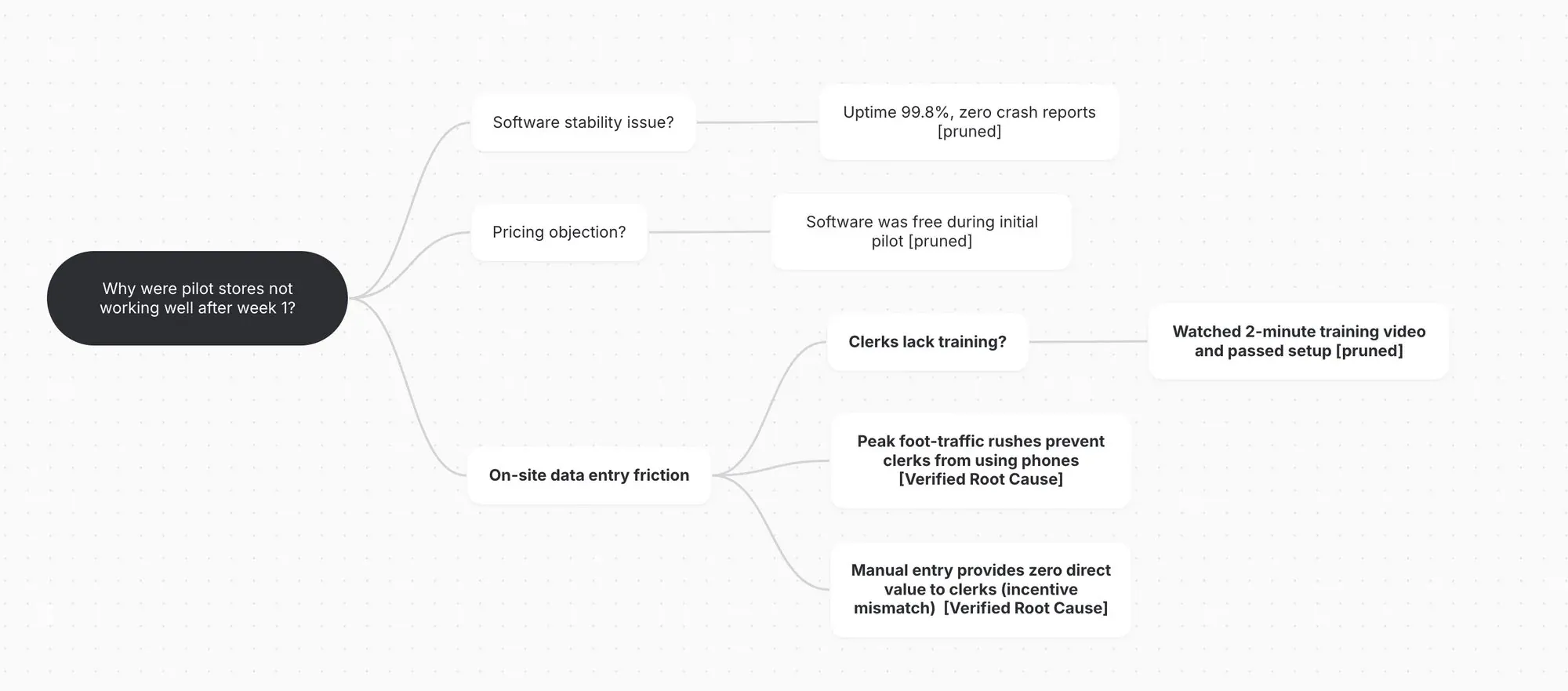
We shadowed clerks on the sales floor and constructed this diagnostic logic tree to prune away irrelevant assumptions:
During peak hours, clerks could not use their phones while busy at the till, packing goods, and managing loss prevention. Because sales commission was the only metric they were measured on, clerks had no personal incentive to submit data. As a result, clerks resisted using the app, privately complaining to store managers that it was impractical and advising them to drop it. Some clerks even asked for pay raises to handle the extra workload, which managers were reluctant to grant. By observing floor operations firsthand, we pruned away irrelevant branches and isolated the genuine constraints within the system.
Strategy 3: Hypothesis-driven iteration (the Goldilocks zone)
When dealing with unknown variables, gathering every available data point causes analysis paralysis. A hypothesis-driven approach focuses on a targeted, testable assumption within the Goldilocks zone: an idea that is neither too costly to test nor already obvious.
- Related reading: Using a hypothesis-driven problem solving approach filters out noise and keeps your team focused on high-signal tests.
Case study (Part 6: Rejecting optical AI for a physical proxy)
Initially, our first impulse was to install overhead optical AI cameras for customer facial and demographic recognition. However, this hypothesis was quickly rejected.
The cost of installing overhead cameras per store was prohibitive. In addition, privacy regulations around customer video surveillance introduced legal liabilities that our small team was not equipped to evaluate or manage.We reframed our hypothesis: Longer dwell time in front of a shelf correlates with purchase intent, and can be measured passively without capturing images or sensitive personal data.
We tested this hypothesis directly. By timing shoppers in front of two busy display shelves over an afternoon, we observed that shoppers spending more than 5 seconds at a shelf resulted in noticeably higher sales (based on an informal on-site sample without formal statistical testing). In-depth interviews with store managers also revealed that customers who spent over 2 minutes in the store had a high likelihood of returning, even without an immediate purchase. Tracking dwell time and zoning key shelves confirmed that this lightweight physical proxy was viable.
Strategy 4: Dynamic navigation via Means-Ends Analysis (MEA)
Static project plans break when unexpected real-world roadblocks appear. Formulated by Allen Newell, J.C. Shaw, and Herbert Simon (1959) for the General Problem Solver, Means-Ends Analysis (MEA) provides a recursive execution loop:
- Measure the distance between your current state and target goal.
- Select an operator (an action or tool) that reduces that distance.
- Check preconditions. If the operator is blocked by an unmet condition, set up a new sub-goal to remove that obstacle. If you reach a dead end, backtrack and pick an alternate operator.
- Related reading: Review how the Means-Ends Analysis (MEA) execution loop systematically clears prerequisite blockers during deployment.
Case study (Part 7: The MEA execution loop)
Below is the chain that guided our hardware deployment:
| Execution stage | Action and decision | State and precondition check |
|---|---|---|
| Top goal | Passively log customer shelf dwell time without clerk input. | Baseline state: 100% reliant on manual clerk entry. |
| Operator 1 (Attempt) | Install wide-angle overhead cameras with edge computer vision models. | Dead end -> Backtrack: Privacy liabilities and per-store hardware costs exceeded budget. |
| Sub-goal 1 | Track human presence without collecting images or video. | Recursive sub-goal triggered. |
| Operator 2 (Attempt) | Mount micro mmWave presence radar sensors to read high/low pin states. | Precondition unmet: Normal aisle foot traffic generated false positives, failing to distinguish passersby from genuine shoppers. |
| Sub-goal 2 | Filter aisle noise to isolate genuine shopper browsing. | Secondary sub-goal triggered. |
| Operator 3 (Resolved) | Calibrate radar sensitivity and detection boundaries: ignore movement under 0.5s as aisle noise; count dwell over 5s as valid interest; zone shelves based on merchandise categories. | Precondition met: Hardware bill-of-materials dropped to $5 to $6 per shelf, installing with adhesive tape in 30 minutes without wiring. |
| Return to top goal | Sensors log dwell seconds automatically and push morning shelf attraction digests to manager chat groups (WeChat morning report). | Top goal achieved: Manual clerk entry eliminated entirely. |
The dual-engine workflow: logic trees + MEA
Many operators ask whether to use a logic tree or Means-Ends Analysis. In practice, they form a complementary pair:
- Logic trees (the map): Provide top-down structural boundaries and prevent teams from chasing local optimizations on the wrong problem.
- Means-Ends Analysis (the navigation engine): Handles execution blockers dynamically by transforming real-world resistance into solvable sub-goals.
Case study (Part 8: Results and limitations)
Outcomes: Two of the three stores ran the system reliably across the full four-week pilot. In those stores, managers checked the automated morning reports at least three times per week. This was a clear turnaround from our pre-intervention pilot, where clerks across all three stores had abandoned manual entry within seven days.
Limitations: This was an early-stage business validation on three stores, not a large-scale double-blind study. However, it demonstrated the strength of pairing both methods: the diagnostic logic tree uncovered the true behavioral constraint, while Means-Ends Analysis guided us through physical and privacy blockers to deploy a workable, low-cost solution.
How do you choose the right problem-solving strategy?
To choose the right problem-solving strategy, evaluate system complexity, the clarity of the underlying cause, and whether the barrier stems from technical mechanics or conflicting stakeholder incentives.
Problem-solving decision matrix
| Problem profile | Common business context | Recommended strategy blend |
|---|---|---|
| Clear rules, visible cause and effect | Routine server patching, onboarding permission handoffs | Checklists + standard operating runbooks |
| Single-cause mechanical failure | Database deadlock error, motor overheating on a line | 5 Whys + fishbone diagram investigation |
| Coupled variables, shifting conditions | Sudden drop in trial retention, rising acquisition costs | 30-second classification -> diagnostic logic tree -> hypothesis validation |
| Clear target, layered implementation blockers | Legacy monolith migration, hardware privacy clearance | Logic tree (global map) + MEA (dynamic navigation) |
| Closed boundaries, deterministic calculation | Cross-bank financial reconciliation, route optimization | Deterministic algorithms + formal verification |
| Ambiguous user needs, unverified demand | Early-stage exploratory product prototyping | Design thinking (empathy interviews + rapid prototypes) |
| Conflicting stakeholder goals (wicked problem) | Platform commission adjustments, remote-work policies | Stakeholder consensus mapping + compromise negotiation |
Frequently asked questions about problem-solving strategies
What are the 4 basic steps of problem solving?
The standard four-step cycle consists of defining the problem, analyzing root causes, developing and evaluating potential solutions, and implementing the solution with continuous monitoring. In complex environments, Step 2 expands into diagnostic logic trees and targeted hypothesis testing.
What is the difference between an algorithm and a heuristic?
An algorithm is a deterministic procedure that guarantees a single correct answer if executed properly, but requires high computational cost and closed rules. A heuristic is an efficient rule of thumb that sacrifices formal perfection to deliver a practical satisficing solution under real-world time and cognitive constraints.
Can you provide a real-world example of business problem solving?
When initial trial retention dropped below 5% (all three stores stopped logging data), our team first ran desk-bound 5 Whys sessions that produced cosmetic form tweaks that failed. By classifying the challenge as a complex adaptive problem, using a diagnostic tree to uncover clerk wage and workflow conflicts, rejecting expensive optical AI cameras due to privacy and legal liabilities, and using Means-Ends Analysis (MEA) to calibrate low-cost $5 to $6 mmWave radar sensors with shelf zoning, the team eliminated manual logging, enabling two of the three stores to run the system stably with managers checking reports three or more times per week.
How should you answer problem-solving questions in an interview?
Use the STAR format (Situation, Task, Action, Result) to structure your communication. Remember that STAR is an interview presentation technique, not an analytical problem-solving strategy. Solve the underlying challenge using diagnostic trees and data verification; use STAR to explain your process clearly to the interviewer.
What is the difference between problem solving and decision making?
Problem solving is an investigative process from an unknown obstacle to an actionable path. Decision making is the specific act of evaluating and selecting among competing alternatives once options are generated. Decision making is one component within the broader problem-solving lifecycle.
Why do the 5 Whys often fail in modern software and operations?
The 5 Whys assumes a single, linear causal chain. In coupled modern software architectures and human organizations, failures emerge from multiple factors interacting simultaneously. Running 5 Whys in a conference room often isolates a single superficial culprit while missing structural systemic issues.
What is Means-Ends Analysis in simple terms?
Means-Ends Analysis works like turn-by-turn navigation: it continuously measures the distance between where you are and where you want to be. When an intended action is blocked by an unmet condition, it automatically turns that barrier into a temporary sub-goal, clears it, and resumes the path forward.
Put problem-solving strategies into practice
When facing a complex business challenge, the hardest hurdle is rarely a shortage of ideas. The real difficulty is untangling the web of assumptions, hidden constraints, and competing arguments inside your team’s head.
Rushing directly into code or process changes risks solving the wrong problem. Lingering in conference-room debates leads to analysis paralysis. Taking the time to map your reality-to-goal gap, prune diagnostic logic trees, and test hypotheses systematically gives your team the clarity to act with confidence.
You can inspect the full reasoning structure behind our retail case study in this interactive proposition tree on FluxLinks. It models each premise, diagnostic prune, and obstacle-clearing sub-goal as an explicit visual hierarchy.
If you are ready to turn tangled thinking into clear, visible structure for your own project, you do not need heavy enterprise project software. Open the FluxLinks Workbench in your browser with no sign-up and no credit card required, lay out your claims and evidence, and start solving your problem from there.
